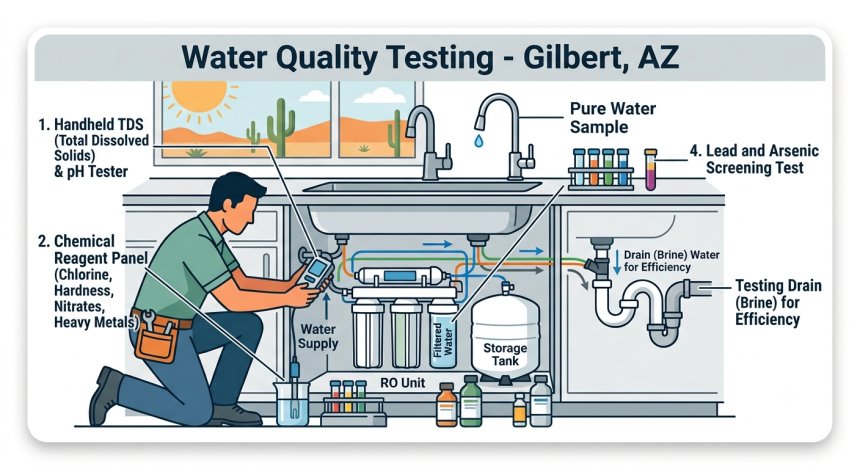
Water Quality Testing in Gilbert, AZ
Water quality can affect how household water looks, tastes, smells, and behaves when it is used for drinking, cooking, bathing, cleaning, and other daily activities. If you notice unusual taste, odor, discoloration, mineral deposits, or changes in water quality, testing can help provide useful information about the condition of the water.
Professional water quality testing in Gilbert, AZ can help homeowners understand specific water characteristics and determine whether additional filtration or water-treatment equipment may be appropriate.
Water quality concerns can have different causes. Some may be related to the incoming water supply, while others can originate from household plumbing, water heaters, filtration equipment, or fixtures.
Testing should therefore be approached as an evaluation rather than an assumption that one particular treatment system is required.
What Is Water Quality Testing?
Water quality testing involves analyzing a water sample for selected characteristics or substances.
Depending on the purpose of the test, evaluation may include:
- Hardness
- pH
- Total dissolved solids
- Chlorine or disinfectant-related measurements
- Iron
- Manganese
- Nitrate
- Other selected parameters
- Microbiological testing through an appropriate laboratory when required
The exact tests should be selected according to the reason for testing and the type of water source.
Why Test Water in Your Gilbert Home?
Homeowners may consider water testing when they notice:
- Unusual taste
- Unusual odor
- Cloudy water
- Discoloration
- Excessive scale
- Changes in water appearance
- Concerns about hard water
- Repeated staining
- Poor performance from water-treatment equipment
- Changes after plumbing work
- Questions about filtration needs
Testing can help distinguish between different water-quality characteristics rather than relying only on appearance or taste.
Common Water Quality Concerns
Household water may have several characteristics that homeowners find undesirable.
Hard Water
Hard water contains dissolved minerals, primarily calcium and magnesium. It can contribute to mineral deposits and scale on fixtures and appliances.
Possible signs include:
- White mineral deposits
- Scale around faucets
- Spots on dishes
- Soap that does not rinse easily
- Reduced efficiency of some water-using equipment
- Dry-feeling skin or hair
A water hardness test can help determine the level of hardness.
Unusual Taste
Changes in taste may be caused by different factors.
Potential causes can include:
- Water characteristics
- Plumbing materials
- Stagnation
- Filtration problems
- Water-treatment equipment
- Disinfectant levels
Testing can help determine which characteristics should be investigated further.
Unusual Odor
An unusual smell may indicate a water-quality concern or a plumbing-related problem.
The source can sometimes be related to:
- Water supply
- Drain system
- Water heater
- Biofilm or organic matter
- Filtration equipment
- Plumbing conditions
The location and timing of the odor can provide useful clues.
Water Discoloration Testing
Discolored water should not simply be ignored.
Brown, yellow, orange, or other unusual colors can have different causes, including changes in plumbing conditions or mineral content.
Possible sources may include:
- Corrosion
- Sediment
- Plumbing work
- Water heater issues
- Disturbance in a water line
- Other water-quality conditions
If discoloration is persistent or unexpected, testing and professional evaluation may be appropriate.
Water Quality Testing and Plumbing Problems
Water quality and plumbing conditions can sometimes affect one another.
For example, old or deteriorating plumbing can influence the appearance or characteristics of water at a fixture.
A professional evaluation may consider:
- Supply lines
- Faucets
- Water heater
- Filtration equipment
- Pipes
- Shut-off valves
- Water source
- Areas where water quality changes
Testing the water alone may not identify a plumbing defect, so physical inspection may also be important.
Water Testing for Hard Water
Hard-water testing is useful when homeowners are considering a water softener or want to understand mineral buildup.
The results can help determine whether a softening system may be appropriate and what type of equipment could be considered.
A professional may evaluate:
- Water hardness
- Household water usage
- Existing softener
- Plumbing layout
- Available installation space
Water treatment should be selected based on actual conditions rather than simply installing equipment without evaluation.
Water Quality Testing Before Installing a Water Softener
Testing can be helpful before purchasing a water softener.
A water hardness measurement can provide information about the mineral content that the softener would need to address.
Other considerations may include:
- Household size
- Water consumption
- Existing plumbing
- Available space
- Regeneration requirements
- Existing filtration
Proper evaluation can help homeowners choose equipment more appropriately.
Water Quality Testing Before Installing an RO System
Reverse osmosis systems are commonly used for drinking-water filtration.
Testing before installation may help identify what type of filtration is needed and whether the selected RO system is appropriate for the home's water characteristics.
Depending on the situation, testing may evaluate:
- Hardness
- Total dissolved solids
- pH
- Selected contaminants
- Existing filtration performance
The exact testing requirements depend on the water source and homeowner concerns.
Water Testing for Existing Filtration Systems
If a filtration system is already installed but the water quality has changed, testing can help determine whether the equipment is still performing as expected.
Potential reasons for reduced performance include:
- Expired filters
- Incorrect installation
- Equipment damage
- Improper settings
- High water usage
- Changes in water characteristics
Testing before and after treatment can provide useful information about system performance.
Water Quality Testing for New Homeowners
People moving into a new home may want to understand their water before installing treatment equipment.
Testing can provide a baseline for:
- Water hardness
- Mineral content
- Selected water-quality parameters
- Filtration needs
A baseline can also be useful when evaluating changes in water quality later.
Water Quality Testing After Plumbing Work
Plumbing repairs or replacements can sometimes temporarily affect water appearance.
Sediment may be disturbed during plumbing work, resulting in temporary discoloration or particles.
After significant plumbing work, homeowners can:
- Follow the plumber's flushing recommendations.
- Observe water appearance.
- Check fixtures for debris.
- Monitor taste and odor.
- Consider testing if concerns persist.
If unusual water conditions continue, professional evaluation may be appropriate.
Water Quality Testing for Well Water
Homes supplied by private wells have different testing considerations than homes supplied by a public water system.
Well owners may need to consider testing based on:
- Local conditions
- Well construction
- Nearby land use
- Changes in water quality
- Applicable recommendations
Because private well water can vary significantly, the appropriate testing panel should be selected according to the specific water source and concerns.
Water Quality Testing for Drinking Water
Drinking-water testing should focus on parameters relevant to human consumption.
Depending on the situation, homeowners may use an appropriately certified laboratory for specific contaminant testing.
A basic home water test may not evaluate every possible contaminant.
When there is a specific health or contamination concern, homeowners should seek appropriate laboratory testing and follow guidance from relevant public-health or environmental authorities.
Water Quality Testing and Water Filters
Testing can help homeowners understand whether a filtration system is addressing the characteristics they are concerned about.
Different filters are designed for different purposes.
For example:
- Sediment filters address particles.
- Carbon filters can address certain taste and odor concerns.
- Water softeners address hardness minerals.
- Reverse osmosis systems provide broader treatment for many dissolved substances.
- Specialized treatment may be required for specific contaminants.
There is no single filter that addresses every water-quality issue.
Testing Water From Different Fixtures
If water quality seems different at different faucets, comparing samples may provide useful information.
For example, if the kitchen faucet has unusual water but another fixture does not, the issue may involve:
- Faucet components
- Local supply tubing
- Point-of-use filtration
- Stagnation
- Plumbing near that fixture
If the same issue occurs throughout the property, the source may be broader.
A professional can help determine which locations should be evaluated.
Signs That Water Quality Should Be Investigated
Consider testing or professional evaluation if you notice:
- Sudden changes in taste
- Persistent unusual odor
- Repeated discoloration
- Excessive mineral deposits
- Water-treatment equipment not working correctly
- Unexpected changes after plumbing work
- Unusual particles in water
- Changes affecting multiple fixtures
- Concerns about a private water source
Testing can provide objective information instead of relying only on visual observations.
Water Quality Testing and Water Heater Problems
Some water-quality complaints may actually originate from the water heater.
For example, unusual odor or discoloration may sometimes be associated with conditions inside the water heater.
A professional may inspect:
- Water heater condition
- Temperature settings
- Anode components where applicable
- Sediment accumulation
- Connections
- Water quality at hot and cold fixtures
Comparing hot and cold water can sometimes help identify whether the water heater may be contributing to the issue.
Water Quality Testing During Home Renovation
Home renovations can be a good time to evaluate existing plumbing and water quality.
If a homeowner is already planning:
- New kitchen plumbing
- Bathroom renovation
- Repiping
- Water filtration installation
- Water softener installation
- RO installation
water testing may help guide equipment decisions.
What Happens During Water Quality Testing?
The exact process depends on the test being performed.
A typical evaluation may involve:
- Discussing the homeowner's concerns.
- Identifying the water source.
- Selecting relevant test parameters.
- Collecting a suitable sample.
- Sending the sample for laboratory analysis when necessary.
- Reviewing the results.
- Considering plumbing or filtration factors.
- Recommending appropriate next steps.
Not every test requires the same collection or analysis method.
Laboratory Water Testing
Some water-quality questions require laboratory analysis.
Laboratory testing can be appropriate when homeowners need information about specific contaminants or when more precise analysis is required.
The testing method should match the question being asked.
Homeowners should also understand what a test does and does not measure. A test for one parameter does not automatically establish that all other water-quality characteristics are acceptable.
Water Quality Testing Cost Factors
Water testing costs vary depending on the type and number of tests.
Factors may include:
- Number of parameters
- Laboratory fees
- Sample collection
- Type of water source
- Testing method
- Additional plumbing inspection
- Specialized contaminant testing
Basic testing and comprehensive laboratory analysis can have significantly different costs.
What to Do After Water Testing
The next step depends on the results.
Possible recommendations may include:
- No treatment required
- Routine maintenance
- Filter replacement
- Water softener installation
- Reverse osmosis installation
- Whole-house filtration
- Plumbing inspection
- Water heater evaluation
- Additional laboratory testing
Treatment should be selected according to the actual issue identified.
Water Quality Maintenance Tips
Homeowners can take several steps to monitor household water quality.
These include:
- Replace filters according to manufacturer instructions.
- Check water-treatment equipment for leaks.
- Monitor changes in taste and odor.
- Inspect visible plumbing.
- Maintain water heaters appropriately.
- Address recurring discoloration.
- Keep records of water testing results.
- Avoid replacing treatment equipment without identifying the actual problem.
Regular observation can help identify changes early.
Frequently Asked Questions
How much does water quality testing cost in Gilbert, AZ?
Cost depends on what needs to be tested, whether laboratory analysis is required, and how many parameters are included. A basic test can differ significantly from specialized contaminant testing.
What does a basic water quality test check?
A basic test may evaluate characteristics such as hardness, pH, total dissolved solids, or other selected parameters. The exact panel varies by testing provider.
How do I know if I have hard water?
White scale, mineral deposits, spots on fixtures, and certain soap-related issues can suggest hard water, but testing provides a more objective measurement.
Should I test water before installing a water softener?
Testing can be useful because it helps determine the actual hardness level and provides information that can assist with selecting an appropriate treatment system.
Should I test water before installing reverse osmosis?
Testing can help identify relevant water characteristics and determine whether an RO system is suitable for the household's needs.
Can plumbing cause changes in water quality?
Yes. Plumbing materials, corrosion, sediment, water heaters, fixtures, and other components can sometimes influence water appearance or characteristics.
Why is my water suddenly discolored?
Possible causes include plumbing work, sediment, corrosion, water heater conditions, or changes in the water supply. Persistent discoloration should be investigated.
Is home water testing enough for every concern?
No. Basic home tests do not measure every possible contaminant. Specific concerns may require laboratory testing using appropriate methods.
How often should household water be tested?
There is no single schedule for every home. Testing frequency depends on the water source, previous results, treatment equipment, local conditions, and any changes in water quality.
Can a plumber help after water testing?
A plumber can evaluate plumbing-related issues and install or service compatible water-treatment equipment. For specialized contamination concerns, appropriate laboratory or environmental professionals may also be needed.
Conclusion
Professional water quality testing in Gilbert, AZ can help homeowners better understand their household water and make informed decisions about filtration, softening, plumbing repairs, or other treatment options.
Water quality concerns can involve many different factors, including hardness, minerals, plumbing conditions, filtration equipment, and water-source characteristics. Testing can provide useful information, but the correct test depends on the specific concern.
If you notice changes in taste, odor, color, mineral buildup, or water-treatment performance, consider having the water evaluated and discussing the results with a qualified plumbing or water-treatment professional in Gilbert, AZ.