Troubleshooting Low Water Pressure in Gilbert Homes
Learn how to diagnose and troubleshoot low water pressure in your Gilbert, Arizona home. Discover common causes, local mineral deposit effects, and practical fixes.

Experiencing a sudden or gradual drop in water flow throughout your house can turn everyday tasks like showering or washing dishes into frustrating chores. When dealing with low water pressure in a Gilbert home, identifying whether the issue is isolated to a single fixture or affecting the entire property is the essential first step toward a correct diagnosis.
Understanding the Problem: Symptoms and Underlying Causes
Low water pressure manifests in a few distinct ways. You might notice a weak trickle from a second-story showerhead, a kitchen faucet that takes twice as long to fill a pot, or appliances like washing machines and dishwashers throwing supply-related error codes. However, not all symptoms point to the same root cause.
The underlying plumbing mechanism relies on a consistent balance of municipal supply pressure, unobstructed piping, and functioning pressure-reducing valves (PRVs). When an obstruction occurs or a mechanical component fails, the flow rate and pressure drop accordingly.
Isolated vs. Whole-House Low Pressure
If only one fixture is affected, the problem is almost always localized to that specific hardware. Aerators, supply line valves, or cartridge assemblies are frequent culprits. When multiple fixtures or the entire house experience low pressure, the issue stems from a broader system failure, such as a failing PRV, a partially closed main water shut-off valve, or extensive mineral buildup inside the piping network.
Practical Troubleshooting Steps and Safe Solutions
Homeowners can safely perform several diagnostic checks before deciding whether professional intervention is necessary.
- Check the Main Shut-Off Valve: Ensure that both the municipal meter valve (if accessible) and your home's main water shut-off valve are fully open. A partially closed valve severely restricts flow.
- Inspect Fixture Aerators: Unscrew the aerator tip from a sluggish faucet. Gilbert's hard water is notorious for depositing calcium and mineral scale inside these fine mesh screens. Soaking the aerator in a vinegar solution overnight often restores full flow instantly.
- Test Multiple Faucets: Turn on cold and hot water taps across different bathrooms and the kitchen simultaneously. If pressure drops drastically when multiple taps are running, your supply lines may be restricted or your water heater inlet may have a partial blockage.
The Role of the Pressure Reducing Valve (PRV)
Most homes in Gilbert are equipped with a PRV, typically located near where the main water line enters the structure. This bell-shaped brass device protects your internal plumbing from excessive municipal pressure. Over time, internal springs fatigue or debris clogs the internal screen, causing the valve to fail and restrict water flow entirely. Adjusting or replacing a PRV requires specialized pressure gauges and mechanical experience, making it a task best suited for a qualified plumbing professional.
Gilbert Local Factors: Hard Water and Mineral Scale
Water supply characteristics play a significant role in long-term plumbing performance. Gilbert's groundwater and Colorado River water supplies carry high levels of dissolved minerals, primarily calcium and magnesium. As water moves through water heaters and piping, these minerals precipitate out, especially when heated.
Over the years, mineral scale accumulates along the inner walls of galvanized or copper pipes, effectively narrowing the interior diameter and reducing water volume and pressure. Unlike surface-level aerator clogs, internal pipe scaling cannot be cleared with standard liquid drain cleaners and often requires professional descaling or repiping evaluations for older properties.
Frequently Asked Questions
How can I tell if my water heater is causing low pressure?
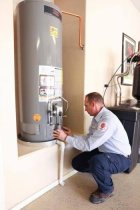
If low pressure occurs only when using hot water across the house, the issue is likely inside your water heater. Sediment accumulation in the tank or a failing inlet valve can restrict hot water distribution while cold water flows normally.
Does low water pressure mean there is a hidden leak?
Not necessarily, but a sudden drop in pressure can sometimes indicate a compromised pipe or slab leak. Check your water meter dial when all household water is turned off; if the low-flow indicator is spinning, a hidden leak may be venting your water supply.
Can I adjust my own pressure-reducing valve to increase pressure?
While PRVs feature an adjustment bolt, turning it without verifying the static water pressure using a hose-bib gauge can over-pressurize your plumbing system, risking burst supply lines and failing appliance hoses. It is always best to measure pressure accurately before making adjustments.
Why is my water pressure lower in the summer than in the winter?
Municipal water demand peaks during hot Gilbert summers as local irrigation and cooling systems run heavily. High municipal demand across the grid can temporarily lower overall supply pressure reaching residential neighborhoods.